

A signal of light in dark times
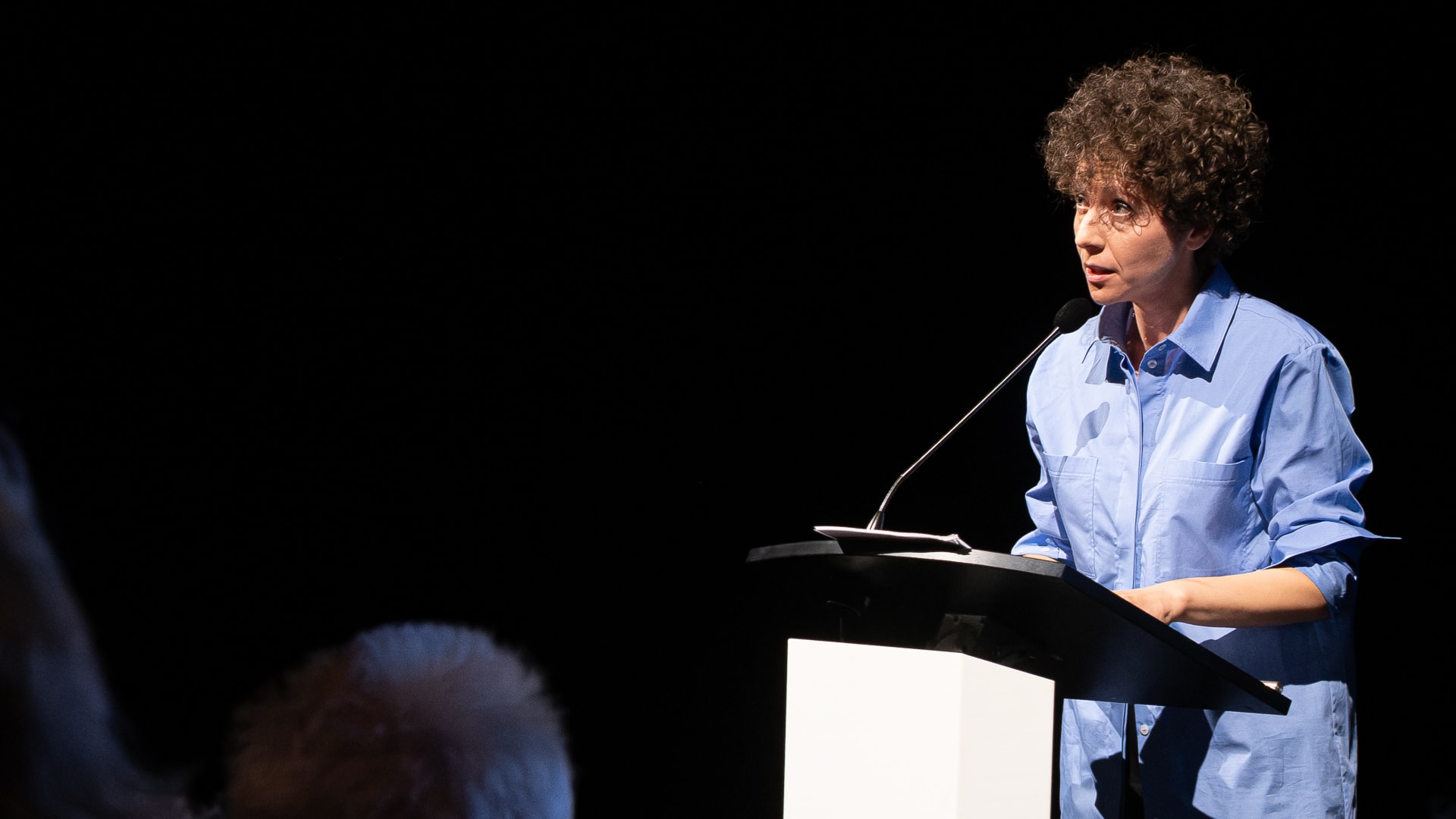
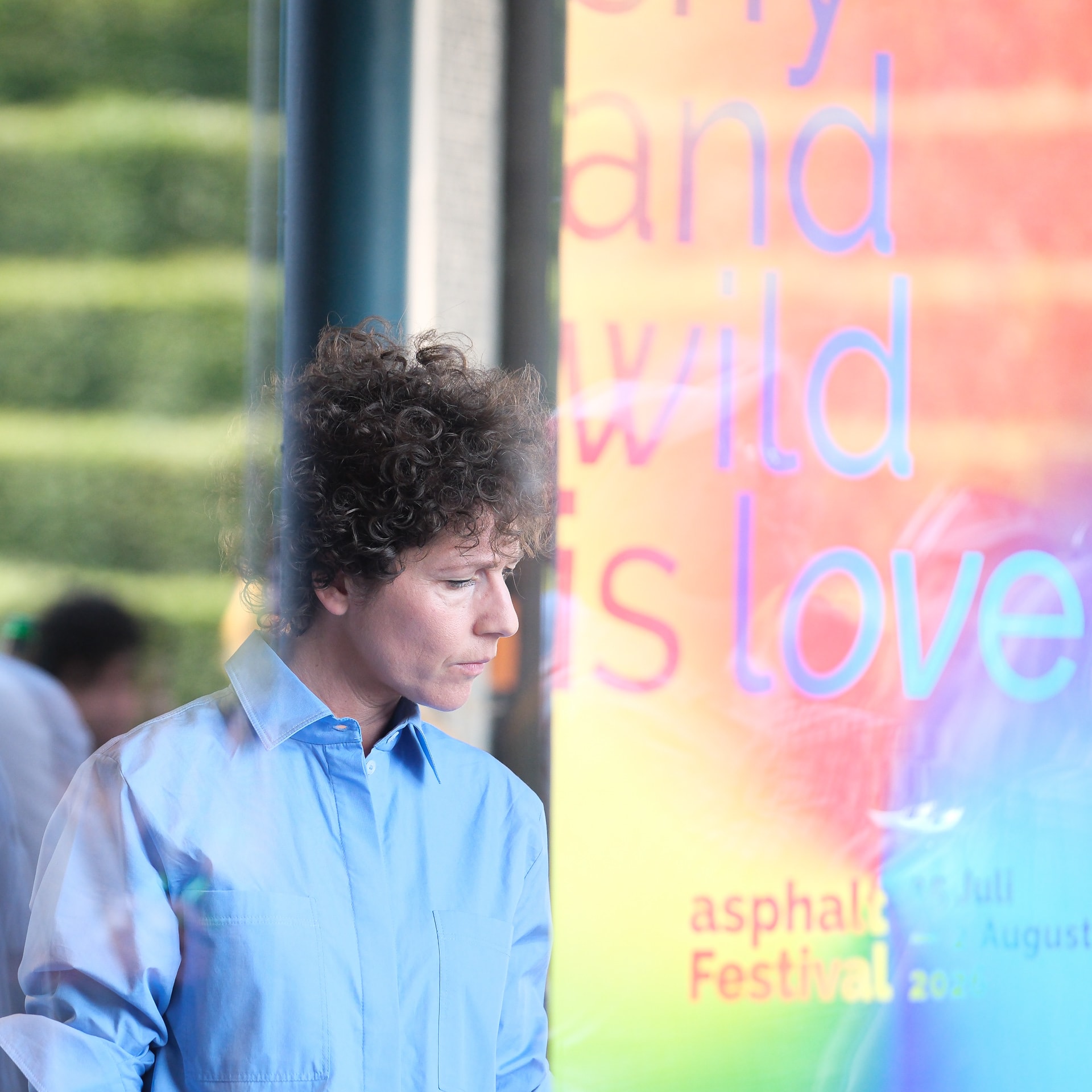
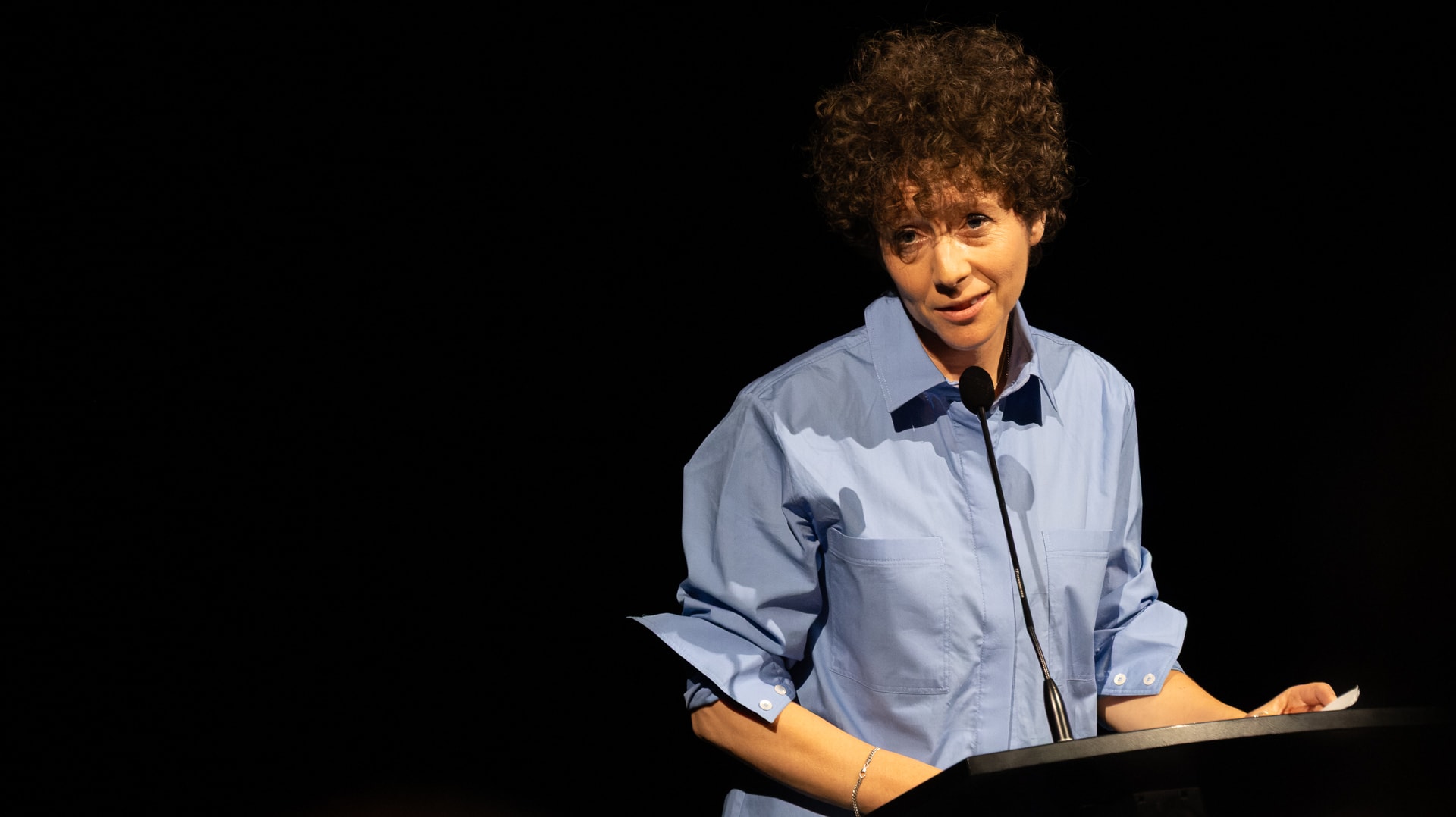
On 15 July 2026, Sasha Marianna Salzmann opened this year’s asphalt Festival with a deeply moving, powerful and, at the same time, poetic opening address. What is the role of theatre, dance and poetry in times of war? How are the horrors of our time reflected in art, how are they enshrined there, and what can art offer as a counterbalance to darkness? We have documented the speech in full.
– 15 July 2026
– – –
this evening, my friends, I am going to bed
early because the darkness is too thick. I will try,
contrary to what’s usual in dreams, not to let
myself be carried away by waves, nor hunt
for my key. I’m going to try to sleep,
I believe, as children do.
These lines by the poet and painter Etel Adnan, were written in 2003, whilst the USA was bombing Iraq. Etel Adnan, born in Beirut to a Greek mother and a Syrian father, spent her whole life moving between Lebanon, France and the USA. When the bombs fell on Baghdad, she was living in California and, as she writes, was trying not to die of rage. The poem from which these verses just quoted are taken begins with the following lines:
I’d have liked to have gone to the corner café,
to watch the cold file by while I’m
in the warm, or even to make love …
but bombs are raining down on Baghdad
Back then, in 2003, I wrote a whole series of poems which I read twenty years later in the volume Zeit. I was desperate and at a loss; I was searching for some kind of guidance – probably for comfort – and I clung to Etel Adnan’s verses. It was a few weeks after 7 October 2023 – the Israeli army’s ground offensive had already begun. I counted the dead in Gaza, repeated the names of the Israeli hostages like a mantra and learnt Adnan’s poems by heart. I searched for more anti-war poems, by Serhij Zhadan and Athena Farroukhzad. I recited them aloud to myself and recorded them for friends who were themselves, or whose families were, living under fire.
My friends wrote back, saying the recordings would bring them a little relief. Or they sent an emoji. Or they said nothing. But in this way I kept in touch amidst what seemed to me to be an ever-deepening darkness that was enveloping us. I was afraid that, amidst all the din of the wars raging around us, I would lose touch with individuals, that I would cease to see people as people and instead view them merely as representatives of the crises and disasters they were going through. No one is merely a survivor, no one is merely a victim. And in art, it seems to me, we rediscover this complexity; there we encounter individual stories in all their contradictions, which do justice to human life. Through art, we remain on the side of lived experience. It helps us not to be overwhelmed by horror stories, statistics and death tolls. By abstraction.
In a poem, a play or a novel, we marvel at an individual’s happiness or mourn their suffering. Not that of a group, not that of a nation. What unites us is not the identical entries in our passports and birth certificates. What unites us is that we are all capable of feeling joy and pain. That is where we meet – in our emotions. And to me, hardly any place seems more suited to this than the theatre. Designed so that we can feel together as we navigate through dark times.
»Truly, I live in dark times,« as Bertolt Brecht’s poem »To Those Who Follow in Our Wake« repeats time and again. That is the certainty that unites us all once more today. Even if we experience it in very different ways and may draw very different conclusions from it.
Recording poems for my friends in need was my way of saying: I cannot ease your pain, but I am here. Despite the darkness, I can see you. As if I were sending out signals of light. I realised this recently whilst being guided through an exhibition at Bellevue Palace in Berlin. The building, the seat of the Federal President, is in urgent need of renovation. In the last two weeks before the palace was finally closed (for many years to come) – the President had already moved out – artists were allowed to use the now-empty rooms for their work. The video artist Bjørn Melhus turned his attention to the windows on the upper floor and installed a light signal there. Three short flashes, three long ones, then three short ones again. In other words: SOS. The exhibition’s curator explained that, for days, alarmed Berliners had been phoning in after passing the palace in the evenings, looking into the windows and believing that the Federal President was trying to tell them something. And indeed – the installation is a cry for help. The despair, transformed into light, of an artist, sending out a signal. His installation at this highly symbolic location in Berlin gave the impression that democracy itself was crying out for help on those sweltering summer nights in June 2026.
I pictured the light in the windows and thought: that’s probably what a work of art always does – it sends out a signal of light. And, in the best-case scenario, this light merges with that of other works of art and other artists, across national borders and across generations, to form a single, radiant whole. And its pulse has this rhythm: three short flashes of light, three long ones, then three short ones again.
And so the poems I recorded for friends shone through to me from another time, and so I wanted to pass them on, like Morse code. I haven’t stopped doing that to this day. There were plenty of occasions. But recently this pulse faltered; I could still see it, but amidst the ceaseless reports of destruction, hunger, mass murder and the madness of our politics, I ran out of strength. I still had so many lines inside me, but they were like fireflies in a preserving jar. The lid was on. They couldn’t get out. I was reminded of a performance by the poet Athena Farroukhzad, during which she quoted another poet, Adrienne Rich, with the following line: ‘There must be those among whom we can sit down and weep, and still be counted as warriors.’
And where is the best place to sit together and cry, yet still be seen as warriors? In the theatre. So this is where I went. To the Maxim Gorki Theatre in Berlin.
After the performance, I sat in the garden with the choreographer and dancer Modjgan Hashemian. Many years ago, I saw her dance piece »Don’t Move«. An evening about how dance is banned in Iran. Especially for women. The programme note at the time read: »This is what life is like in Tehran. You don’t walk through the city, you don’t move, you don’t use your legs. In the end, you become this person without legs. … There’s this rumour that the earth in the city has greater gravitational pull than elsewhere; we call it ›heavy earth‹.«
That evening, I told Modjgan that I would soon be seeing another dance piece, »This is not a dance« by Nastaran Razawi Khorasani – which is opening this festival today – which, much like her work back then, deals with the ban on dance in Iran. And Modjgan beamed at me and said, in essence: »You see. It will always go on. We’re all weaving this tapestry together. A shared narrative. All the massacres, all the oppression. But we pop up here and there and tell our stories. And as long as we do that, we too will keep on existing.«
Modjgan Hashemian lives in Berlin, Nastaran Razawi Khorasani in Rotterdam. All over the world, I imagine, this defiant narrative resounds – the story of people who challenge rigid political systems. By bearing witness and by creating beauty. They stand up to dictatorship, authoritarianism and injustice with their pulsating light.
Once the history books have been rewritten and the daily news no longer reports on them, the memory of the crimes and injustices will be to be found in works of art. In a poem, in a dance, in a line from a play.
It is artists who ensure that the names of those who have been erased from mainstream narratives are not forgotten.
The other day, in the garden of the Gorki Theatre, Modjgan Hashemian vigorously brushed her hands on her jeans, stood up and, before she left, quoted a Greek poet, Dinos Christianopoulos, by way of farewell: »What didn’t they do to bury us? But they forgot that we are seeds.« Modjgan’s energy got me going again, too. I thought about the name of the festival that’s opening here today. And suddenly I had a picture in my mind of a road that had been torn up, and of what we like to call weeds pushing their way up into the light through the cracks in the tarmac.
»A sunflower bursts through the ground.« So reads a stage direction in the play »Cleansed« by the playwright Sarah Kane. It is perhaps her most uncompromising text. Kane demanded every conceivable extreme from the stage area. And she insisted that on stage everything must be possible. That everything must be made possible. For theatre is the place where we exercise our imagination. The place where even a utopia can become reality. I am certain that the creators whose works we will be seeing over the next few days share this view: imagination forges its way into the light, breaking through the ground. Through the tarmac. Because we are seeds. We work our way persistently through the »heavy earth«. Through the darkness.
And because that is the case, art does not necessarily need a beautiful theatre building to take place. During this festival, we will see performances in industrial sites, museums, churches, private homes, office blocks and public spaces. We can count ourselves lucky, for these spaces remain undamaged. But art also takes place in trenches, in hospitals that are barely intact, and in the ruins of bombed-out cities. And I try to imagine that what will happen here on Düsseldorf’s stages over the next few days is connected to works of art all over the world.
Just imagine: right now, at this very moment, someone is dancing in Rafah, in Khartoum, in Isfahan, in Odessa. On makeshift stages, in open fields, on torn-up roads.
Please do not misunderstand me: I do not believe that the primary role of art is to offer resistance. I realise that not every work of art cries out for help. And I find it questionable to demand of art something that politics and civil society must, first and foremost, achieve themselves. The battle for our democracy will not be won on theatre stages.
All the more reason, in times like these, for us to fight to guarantee the freedom and independence of theatres, for art can only succeed if it refuses to be taken into service and does not bow to any political doctrine.
And yet, whenever I enter a theatre or write for one, I must bear in mind that theatre, by its very nature, is the most political of all the arts. Because it invites the people, invites them to come together. Because you are all present. Because we share space and time. Because theatre always exists only in the plural, and every single theatre represents a society in miniature. Or at least the vision of a society as we imagine it.
Today this festival begins in the dark: Nastaran Razawi Khorasani’s dance piece »This is not a dance« will mask the light to show what is hidden in the shadow. At the same time, Florentina Holzinger’s »A Year without Summer« will take place. The starting point for this performance is the memory of the year 1816, when the sun was obscured by volcanic ash and the world was plunged into a never-ending night. Nevertheless, this evening, and every evening over the next few days, will shine. Because they are a pulse of light. And they connect with one another, across the entire globe.
The poet Maria Stepanova, who has been living in exile in Germany since Putin’s escalation of the war in Ukraine, was recently asked how she defies the centrifugal forces of history. Where she draws her strength from. Maria Stepanova replied: »Look, we all know that we have entered dark times. And none of us can see the light at the end of the tunnel. So, we have to create light along the way.«
I asked her what this light might be on our journey through the dark tunnel. The poet smiled and said: »Well, for me it is certainly a poem. Not for all of us, though. But it is probably true for everyone that other people give us light. So maybe: a good encounter.«
Perhaps that is the best definition of what theatre really is: a meaningful encounter. And this does not take place in a space of cosy self-affirmation, but rather in one of productive debate. Of creative friction. In the echo chamber of an art form that challenges me and helps me arrive at a new thought. At a new emotion. At best, I catch myself thinking I was on the side of the righteous, where I certainly do not belong. Because there is no such thing as the righteous. We are all fallible. And that, too, is what art is for: to make us realise this.
Time and again, Hannah Arendt, the grand master of productive debate, wrote about men in dark times. In one of these essays, she states: »However deeply we may be affected by the things of the world, however deeply they may stir and stimulate us, they become human to us only when we can discuss them with our fellows.«
So, this evening, my friends, let us not go to bed early. Tonight and on the nights to come, let us stay up late, talking and debating in the canteen. We shall meet again at the panels and discussions. And when we run out of breath, when our strength fails us and we can no longer think of any more poems – that is precisely when it is good to be together.
There must be those among whom we can sit down and weep, and still be counted as warriors.
Thank you.
– – –
Sasha Marianna Salzmann is a prose and playwright, essayist, dramaturg, and curator. She was co-editor of the culture and society magazine “freitext” and resident writer at the Maxim Gorki Theater in Berlin, where she also directed the “Studio Я” theater stage. Together with Max Czollek, she organized the Disintegration Congress and the Radical Jewish Culture Days; she also curated the festivals “Utopia Eastern Europe” and “What Would James Baldwin Do?” Salzmann’s novels and plays have been translated into over 20 languages and have received numerous awards, including the Literaturhäuser Prize, the Hermann Hesse Prize, the Berlin Art Prize, and the Kleist Prize.