

“A question of language and respect”
Dr. Bastian Fleermann, director of the Düsseldorf Memorial and Remembrance Site, on the relevance of the Majdanek trial for the city. Recorded by Christof Seeger-Zurmühlen.
– May 25, 2021
“The process took place in a way that we can no longer imagine today.”
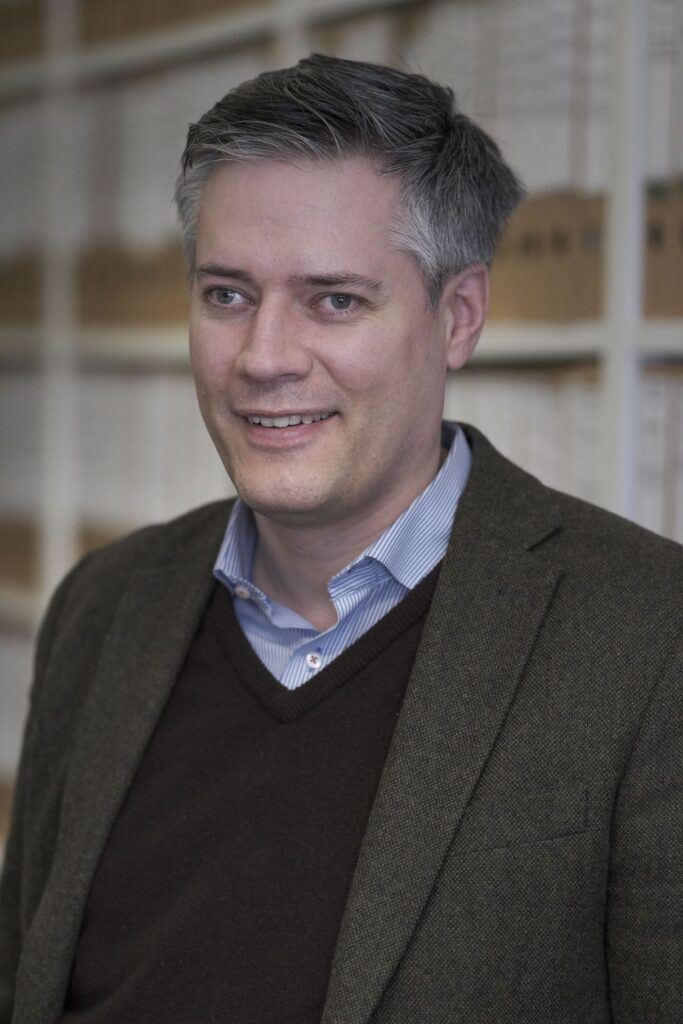
Photo: Michael Gstettenbauer
“The extent to which the Düsseldorf population is aware of the Majdanek trial today is a generational issue. I believe that people who were already adults living in Düsseldorf in the 1970s have a rough recollection of the Majdanek trial. And I also believe that the younger generation, who were not taught about it, know nothing about it.
There are a whole series of trials that are very little known. What we know in the general public are mostly only the Auschwitz trials from 1963 and 1965 in Frankfurt. But Majdanek III – that is, the Düsseldorf Majdanek trial – must be counted among the really big, important trials in the Federal Republic’s judiciary.
The Majdanek camp is often referred to as the “Lublin-Majdanek camp” or simply “Lublin.” It was initially a prisoner-of-war camp. But it quickly became clear that the prisoner population here was very diverse. From the spring of 1942, three extermination camps were established in the General Government – Belzec, Sobibor, and Treblinka. These were the camps of the so-called “Aktion Reinhardt,” which served to exterminate the Jewish population in the General Government. The interesting thing is that Majdanek was not integrated into this system. This is because Majdanek also housed large numbers of non-Jewish Poles, political opponents or those who were considered to be such. There were also Soviet prisoners of war there. There were Jews there, but Majdanek cannot be integrated into the clear context of “Aktion Reinhardt.” However, the grand finale of this complex of crimes is a crime that took place largely in Majdanek. This means that Majdanek was indeed drawn into the context in the final days of this murder program, when 43,000 Jewish people in the greater Lublin area were shot in the cynically named “Operation Harvest Festival.”
To this day, we do not know exactly how many people died or were murdered in Majdanek. According to Tomasz Kranz, the current director of the Majdanek-Lublin Memorial, 78,000 victims have been confirmed.
Very early on, namely in the second half of the 1940s, the Polish judiciary dealt with the crimes committed in Majdanek and brought them to justice. Majdanek I and Majdanek II in Lublin were show trials in which SS criminals were tried and many of them hanged.
A trial with 15 years of preparation
At the end of November 1975, the major trial “Majdanek III – Proceedings against Hackmann and others” began here in Düsseldorf, in the courtroom of the then regional court. This trial did not begin in a vacuum. It actually began in 1960, meaning that there was a 15-year preparation phase before the proceedings were initiated. Research was conducted, expert opinions were obtained, and suspects and witnesses were questioned by the Cologne public prosecutor’s office. It was clear to everyone involved that it would be a mammoth trial. And some may have suspected even then that it would ultimately become the longest trial in the history of the Federal Republic.
The trial proceeded in a way that we can no longer imagine today. Former Nazis sat in the audience, loudly expressing their solidarity with the defendants. There were repeated scandals and interruptions. Over 350 witnesses from all over the world were invited to Düsseldorf. Many traumatized survivors who had lost all their family members in Majdanek and had themselves been prisoners there were harassed by completely ruthless defense attorneys. But the most shocking thing was the outcome. The verdicts were generally considered too lenient, too lax. They were heavily criticized at home and abroad and by the press, and quite a few people even considered them scandalous. That is what we today criticize about the Majdanek trial in Düsseldorf. But we also have a duty, at least in my opinion, to give this trial credit for one thing. It seems to me that it represents an extremely thorough examination of the complex of crimes. This trial has greatly advanced the investigation of the crimes in Majdanek. And it has also had a significant impact in Düsseldorf.
The reason why the Majdanek trial took place in Düsseldorf can only be answered with relative banality. There were no connections to Düsseldorf, at least none worth mentioning. Düsseldorf was chosen because of the experience with the Treblinka trial of 1965 against Kurt Franz from Düsseldorf and others. It should not be forgotten that the Majdanek trial was not prepared in October 1975 and began in November, but that intensive work on the Majdanek trial had already been done during the Treblinka trial. And all of this probably led to the decision to go to Düsseldorf.
“The extent to which the Düsseldorf population is aware of the Majdanek trial today is a generational issue. I believe that people who were already adults living in Düsseldorf in the 1970s have a rough recollection of the Majdanek trial. And I also believe that the younger generation, who were not taught about it, know nothing about it.
There are a whole series of trials that are very little known. What we know in the general public are mostly only the Auschwitz trials from 1963 and 1965 in Frankfurt. But Majdanek III – that is, the Düsseldorf Majdanek trial – must be counted among the really big, important trials in the Federal Republic’s judiciary.
The Majdanek camp is often referred to as the “Lublin-Majdanek camp” or simply “Lublin.” It was initially a prisoner-of-war camp. But it quickly became clear that the prisoner population here was very diverse. From the spring of 1942, three extermination camps were established in the General Government – Belzec, Sobibor, and Treblinka. These were the camps of the so-called “Aktion Reinhardt,” which served to exterminate the Jewish population in the General Government. The interesting thing is that Majdanek was not integrated into this system. This is because Majdanek also housed large numbers of non-Jewish Poles, political opponents or those who were considered to be such. There were also Soviet prisoners of war there. There were Jews there, but Majdanek cannot be integrated into the clear context of “Aktion Reinhardt.” However, the grand finale of this complex of crimes is a crime that took place largely in Majdanek. This means that Majdanek was indeed drawn into the context in the final days of this murder program, when 43,000 Jewish people in the greater Lublin area were shot in the cynically named “Operation Harvest Festival.”
To this day, we do not know exactly how many people died or were murdered in Majdanek. According to Tomasz Kranz, the current director of the Majdanek-Lublin Memorial, 78,000 victims have been confirmed.
Very early on, namely in the second half of the 1940s, the Polish judiciary dealt with the crimes committed in Majdanek and brought them to justice. Majdanek I and Majdanek II in Lublin were show trials in which SS criminals were tried and many of them hanged.
A trial with 15 years of preparation
At the end of November 1975, the major trial “Majdanek III – Proceedings against Hackmann and others” began here in Düsseldorf, in the courtroom of the then regional court. This trial did not begin in a vacuum. It actually began in 1960, meaning that there was a 15-year preparation phase before the proceedings were initiated. Research was conducted, expert opinions were obtained, and suspects and witnesses were questioned by the Cologne public prosecutor’s office. It was clear to everyone involved that it would be a mammoth trial. And some may have suspected even then that it would ultimately become the longest trial in the history of the Federal Republic.
The trial proceeded in a way that we can no longer imagine today. Former Nazis sat in the audience, loudly expressing their solidarity with the defendants. There were repeated scandals and interruptions. Over 350 witnesses from all over the world were invited to Düsseldorf. Many traumatized survivors who had lost all their family members in Majdanek and had themselves been prisoners there were harassed by completely ruthless defense attorneys. But the most shocking thing was the outcome. The verdicts were generally considered too lenient, too lax. They were heavily criticized at home and abroad and by the press, and quite a few people even considered them scandalous. That is what we today criticize about the Majdanek trial in Düsseldorf. But we also have a duty, at least in my opinion, to give this trial credit for one thing. It seems to me that it represents an extremely thorough examination of the complex of crimes. This trial has greatly advanced the investigation of the crimes in Majdanek. And it has also had a significant impact in Düsseldorf.
The reason why the Majdanek trial took place in Düsseldorf can only be answered with relative banality. There were no connections to Düsseldorf, at least none worth mentioning. Düsseldorf was chosen because of the experience with the Treblinka trial of 1965 against Kurt Franz from Düsseldorf and others. It should not be forgotten that the Majdanek trial was not prepared in October 1975 and began in November, but that intensive work on the Majdanek trial had already been done during the Treblinka trial. And all of this probably led to the decision to go to Düsseldorf.
Families still maintained a strict silence
The Majdanek trial was accompanied by protests almost throughout. Many contemporary witnesses say that the broadcast of the TV series “Holocaust” on WDR in 1979 was a key experience for them and their families. But Majdanek was largely before 1979. This means that families still kept silent at that time. And this globally acclaimed trial brought the topic of the Holocaust to the forefront of current affairs, and people naturally began to ask questions. There were protests from church and trade union groups, as well as from the Association of Victims of Nazi Persecution. There were protests from the German Communist Party (DKP) and also from the “post-68 generation.” There were protests by the Jewish communities. Some of the protests were very creative, with vigils being held here. Mühlenstraße was illegally renamed Majdanekstraße.
Günter Bogen, the presiding judge, invited young people from Düsseldorf to take seats in the back third of the courtroom to listen to the trial. He was also heavily criticized for this. But he went through with it. And when these young people left the courthouse in the evening and went home, they knew everything about Majdanek, in every detail. But they knew nothing about their own hometown of Düsseldorf and developed a desire to have a living memorial in Düsseldorf. They demanded a memorial from the Düsseldorf city council. The politicians agreed, but there was a misunderstanding, a misunderstanding between the generations. Until then, a “memorial” had been a plaque, a bronze statue, or a figure. But the generation of young students, trainees, and pupils in the 1970s and 1980s did not want to support such a static understanding of what a memorial should be. This misunderstanding was then resolved when these young people said: We want an active place of learning. With scientifically qualified staff and an education department that enables pedagogical historical learning. We want a place where permanent, temporary, and special exhibitions can take place. A space where we can discuss, where encounters can take place. Where you can watch films, where you can engage with the subject matter. Actively.
Our memorial and remembrance site was opened in September 1987, and I would argue that this impetus would not have existed without the Majdanek trial here on this street. I am convinced that the Majdanek trial was the impetus that forced Düsseldorf to confront not only Majdanek or Auschwitz or Treblinka, but above all Düsseldorf, the history and past of its own city. And in this sense, it was also the impetus for establishing a central municipal memorial and remembrance site. In this respect, the old courthouse and our memorial are intertwined and interlinked. That is why the trial, the memory of the trial, and the process of coming to terms with it are also a crucial part of our institute’s soul or identity.
I believe that many people are unaware that this institute is a result of the trial. A by-product, but a significant one nonetheless. And I believe that this can also be made clear to the public: that despite all the scandals and lenient sentences, Majdanek III also had these positive side effects and that today – decades after the trial – we know much more about Majdanek than we did before.
Of course, our work today is no longer comparable to that of the 1980s, because the institute has developed enormously. But there are basic principles in this institute that were defined here in the mid-1980s and that we continue to pursue. Relatively stubbornly. We are not a silent mausoleum, but an active place where city history is discussed. We offer both educational work and research; these are constants that we have never abandoned here. Incidentally, we also firmly believe that this institution was never a Holocaust memorial or a Jewish museum, but that we have always been and continue to be equally dedicated to all groups of victims. In our permanent exhibition, we always strive to focus on all persecuted groups. This includes small, marginalized victim groups such as Jehovah’s Witnesses and gay men. We take a very biographical approach. We delve very specifically into history. We don’t want to be abstract. We want to limit ourselves to Düsseldorf in order to take a closer and more precise look.
In June 2021, we commemorated the Majdanek trial together with the asphalt Festival. We did so artistically, documentarily, and through a shared stance. We commemorated the culture of protest and, in the broadest sense, we also commemorated the victims of Majdanek.
Looking at it more specifically, I would say the following: The series of scandals and unpleasant scenes in the courtroom at that time had a lot to do with language. In the Majdanek trial, a tone emerged that was very agitated and aggressive. How eyewitnesses, survivors, and contemporary witnesses were treated is a question of language and respect. These are actually the two key concepts. If we look again at this very specific aspect of the trial, this overall mood, this atmosphere that is created by language, then we can learn from it today: language is always a very important instrument for doing wrong or inflicting violence.”
– – –
Dr. Bastian Fleermann (born 1978) holds a doctorate in history. He was born in Ratingen and studied history, folklore, and Rhineland regional studies in Bonn. Since 2011, he has been director of the Düsseldorf Memorial and Remembrance Site at Mühlenstraße 29.
The theater collective Pièrre.Vers’ production “IM PROCESS” about the Majdanek trial celebrated its premiere on June 30, 2021, as part of the asphalt Festival in the Berger Church in the old town.Dr. Bastian Fleermann (*1978) ist promovierter Historiker. Er wurde in Ratingen geboren und hat in Bonn Geschichte, Volkskunde und Rheinische Landeskunde studiert. Seit 2011 leitet er die Mahn- und Gedenkstätte der Stadt Düsseldorf auf der Mühlenstraße 29.
Die Inszenierung ›IM PROCESS‹ des Theaterkollektivs Pièrre.Vers über den Majdanek-Prozess feierte am 30.06.2021 im Rahmen des asphalt Festivals ihre Uraufführung in der Berger Kirche in der Altstadt.