

»Dignity is the foundation of our existence«
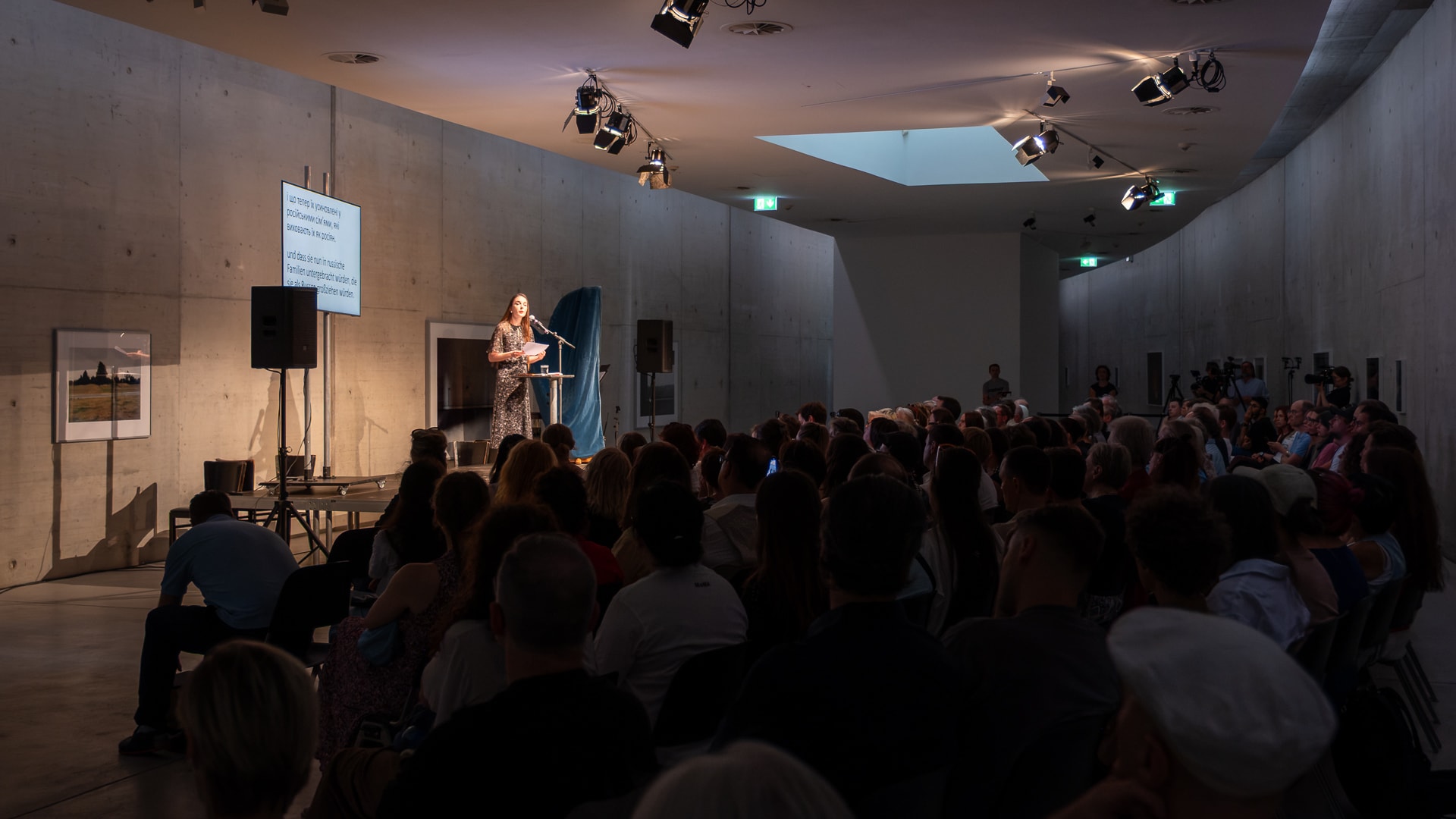
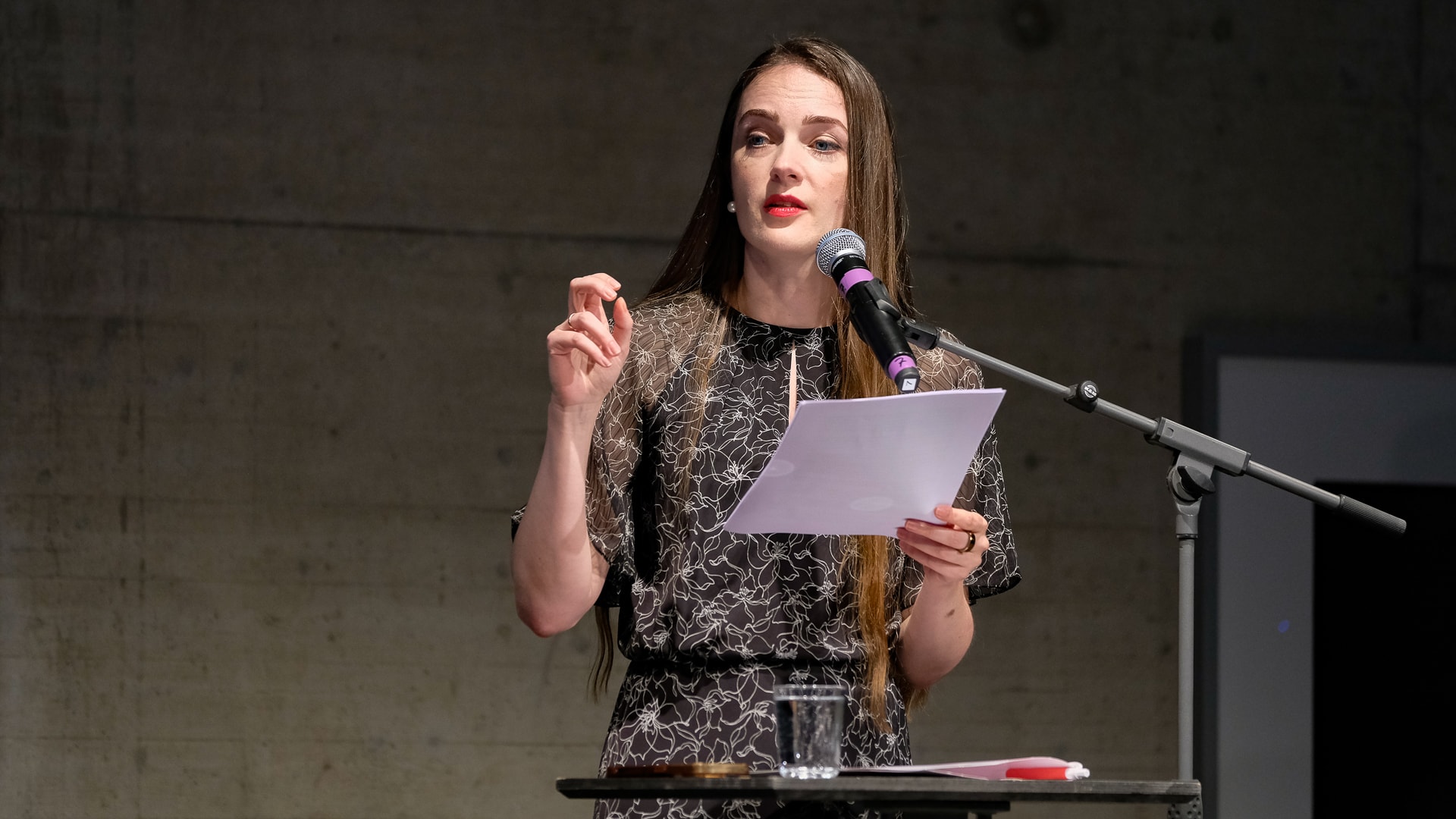
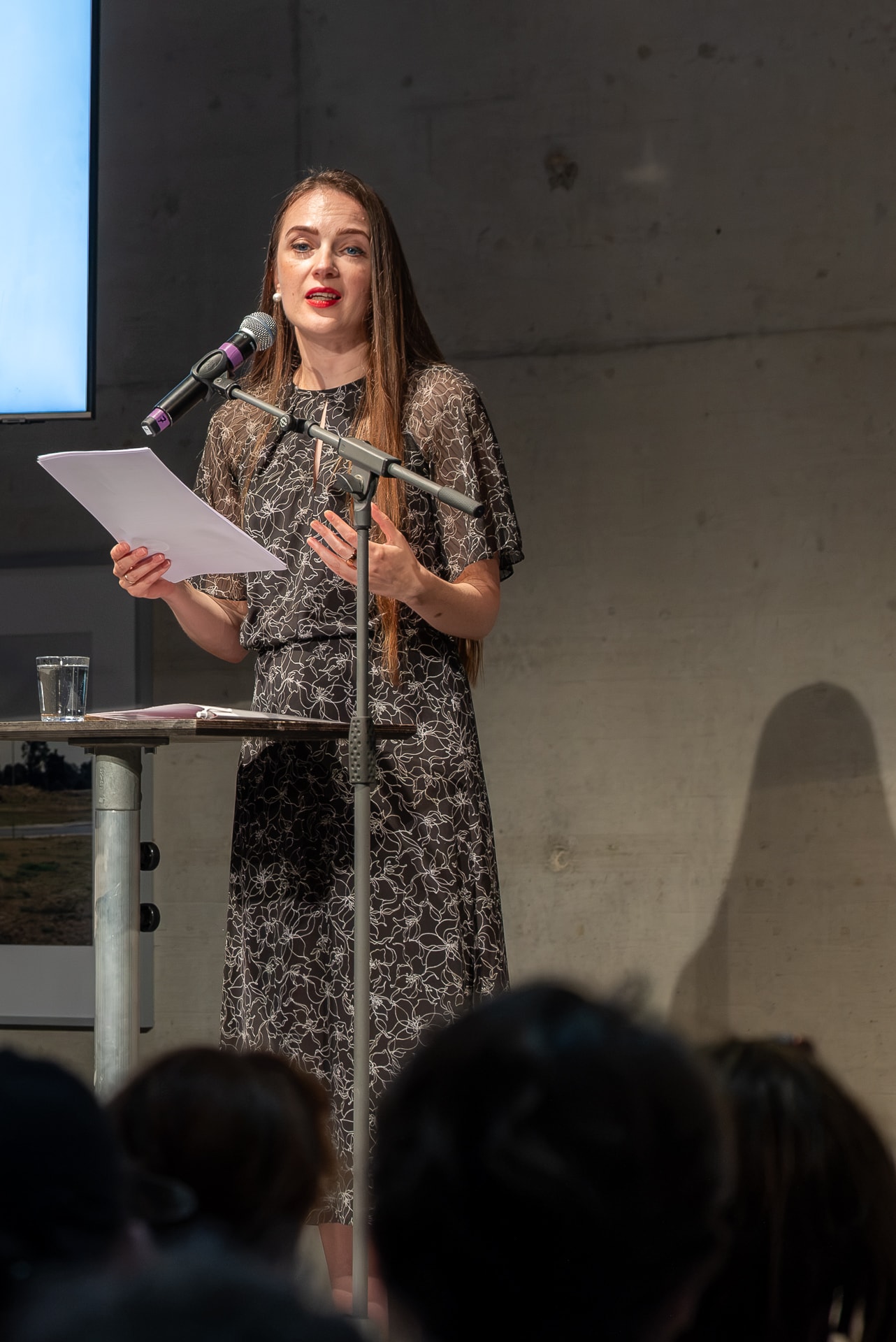
Oleksandra Matviichuk, the Ukrainian Nobel Peace Prize laureate and human rights lawyer, was a guest at the asphalt Festival on 17 July. She delivered a powerful speech on how freedom, democracy and human dignity can be defended in a world where violence is increasingly supplanting international rules. For Russia’s war of aggression against Ukraine is putting not just one country, but the fundamental values of democratic societies to the test. We present the full text of the speech.
– 18 July 2026
– – –
Oleksandra Matviichuk is the world’s best-known activist in the Ukrainian human rights movement. In 2022, the Centre for Civil Liberties, which she heads, was awarded the Nobel Peace Prize. A lawyer and human rights advocate, she is passionately committed to defending freedom and human dignity in Ukraine and across the OSCE region. She has authored numerous reports for UN bodies, the Council of Europe, the EU, the OSCE and the International Criminal Court. Matviichuk has many years’ experience in documenting violations of international law and human rights during armed conflicts and, together with other partners, founded the »Tribunal for Putin« initiative. She also has extensive expertise in engaging citizens in human rights activities to counter attacks on rights and freedoms. Matviichuk has received numerous awards for her work.
I am a human rights lawyer. I document war crimes committed during this war that Russia launched against Ukraine. While this war reduces people to numbers, we give them back their names. After all, people are not numbers. Every person’s life matters.
Let me share one story from our database. This is the story of 10-year-old Ilya from Mariupol. When Russian troops surrounded the city, they prevented the International Committee of the Red Cross from opening a »green corridor« to evacuate civilians. As a result, Ilya and his mother took shelter from Russian shelling in the basement of their home. Like many other residents of the city, they melted snow for water and lit a fire to cook at least a little bit of food. When their supplies ran out, they had to go outside and found themselves under Russian shelling. The mother was wounded in the head, and the boy’s leg was torn apart. With her last ounce of strength, the mother dragged her son to a friend’s apartment.
There was no medical assistance. Prior to this, the Russians destroyed the maternity hospital and the entire medical infrastructure in Mariupol. That is why once inside the apartment they lay down on the couch and just hugged each other. They were lying like that for several hours. Ilya told my colleague that his mother had died and frozen to death right in his arms.
I have one question. How will we, as people of the 21st century, protect people, their lives, freedom, and dignity? Can we rely on the law—or does only brute force matter?
This is important to understand not only for the people of Ukraine, Syria, Sudan, Myanmar, Nicaragua, or Venezuela. The answer to this question determines our shared future.
First, I do not know what future historians will call this period. But the international order based on the UN Charter and international law has collapsed. This system was created after World War II to protect people from war and mass violence. But even my phone has an expiration date. This system was never reformed. And now it’s simply stalling, going through the motions. We will never return to the way things were. Change is the new normal.
Second, Ukraine has found itself at the epicenter of events that will shape the new world order. This is not a war between two states—it is a war between two systems: authoritarianism and democracy. Putin seeks to prove that a country with powerful military capabilities and nuclear weapons can disrupt the international order, dictate its own rules to the global community, and even use force to alter internationally recognized borders. If Putin succeeds, it will change people’s perceptions of what is acceptable.
Third, we are losing our freedom in the world. Future generations in Western democracies have inherited democracy from their parents. They have come to take rights and freedoms for granted. They have become consumers of democracy. They understand freedom as the ability to choose between different kinds of cheese at the supermarket. That is why they are willing to trade freedom for economic benefits, promises of security, or personal comfort.
Fourth, people only begin to realize that a war is starting when bombs are falling on their heads. But war also has an informational dimension. People are spending more and more time in a virtual space polluted by fake news and disinformation. As a result, they are losing the ability to distinguish between truth and lies. Now, even members of a small community no longer share a common understanding of reality. Without a shared understanding of reality, people are unable to act together. And without collective action, how can we protect our democracy?
Many things in this world are not confined by national borders. And it is no coincidence that I want to talk about one such thing: the role of culture in achieving a just and lasting peace.
My first thesis: Russia’s war is genocidal
Putin openly declares that there is no Ukrainian nation, no Ukrainian language, and no Ukrainian culture. For many years, we have witnessed how these words are put into horrific practice.
In the occupied territories, the Russians are physically eliminating active members of society—mayors, journalists, children’s authors, priests, musicians, teachers, and entrepreneurs. They are banning the Ukrainian language and culture. They are plundering and destroying Ukraine’s cultural heritage. They are sending Ukrainian children to so-called »re-education« camps, where they are told that they are not Ukrainians but Russians – that their parents or relatives have abandoned them, and that they have now been adopted by Russian families who will raise them as Russians.
Russia is trying to portray our resistance to the occupation and the destruction of Ukrainian identity as actions that »undermine peace«. That is why we are forced to constantly explain what is obvious to us but not to the world.
Peace does not come when a country under attack stops defending itself. That is not peace – it is occupation. Occupation is war itself, just in a different form. Occupation is not simply replacing one flag with another. It is forced disappearances, rape, torture, the aggressor adopting your children, the denial of your identity, filtration camps, and mass graves.
Russia is an empire. An empire has a center but no borders. An empire always seeks to expand. When Putin told Trump in Alaska that he would wage war to eliminate its »root causes«, those root causes are our very existence. After all, to destroy a national group, it is not necessary to kill all its members. You can forcibly erase their identity, and the entire national group will disappear.
We cannot stop resisting Russian aggression. If Russia occupies Ukraine, we will simply cease to exist. Nations that grow weary of fighting for their identity disappear.
My second thesis: The war is changing how Ukrainians are perceived in the world.
Every nation is a narrative—a story it tells about itself. But for centuries, Ukrainians lived in the shadow of the Russian Empire. And an empire isn’t just about control over land, resources, and people. It’s about control over knowledge—over how we speak about one another. It’s the power to call things by their proper names.
As a society, we entered this full-scale war without any context. People on other continents knew only one thing about our part of the world: that it was »Russia«. Our history was not written by us. We are a country whose literary classics have not even been translated. Even today, people still ask me whether the Ukrainian language is actually different from Russian.
In response, I often tell the story of a painting by Edgar Degas at the Metropolitan Museum of Art. It depicts young women in traditional dress. For many years, the painting was titled »Russian Dancers« – but the girls are wearing vyshyvankas and flower wreaths, that is traditional Ukrainian clothing. For years, Ukrainian art historians sent letters requesting that the painting be renamed or at least accompanied by an explanatory note. No one listened.
It was only after the full-scale invasion that the Metropolitan Museum changed the title. It is now titled »Dancers in Ukrainian Costumes«. The museum administration likely still believes these are Russian dancers who just happen to be wearing Ukrainian costumes – but it’s a significant change nonetheless. Ukraine is beginning to appear on the world’s mental map. Unfortunately, at the cost of very heavy losses.
We are a vivid example of the fact that a country’s independence is measured not by its national income or the possession of nuclear weapons, but by the willingness of its citizens to defend their freedom—the freedom to be an independent state, not a Russian colony. The freedom to preserve our identity, rather than »re-educate« Ukrainian children to become Russians. The freedom to make democratic choices—the opportunity to build a country where every person’s rights are protected, where the government is accountable and transparent, where the courts are independent, and where the police do not beat or disperse peaceful student demonstrations.
At the same time, this war is far from the only hotspot on the planet. The humanitarian crisis and military conflict in Sudan have been ongoing for over 20 years. Millions of women in Afghanistan are forbidden to speak in the presence of men. One-third of all imprisoned writers in the world are held in Chinese prisons. And right now, many people in different corners of the world are fighting for their freedom and human dignity. Only a few of them make the front pages of the global media.
If Ukraine is perceived solely through the lens of Russian crimes and victimhood, while Russia is seen through the prism of its »great culture«, we will lose. Images of bodies on the streets of Bucha or the destroyed drama theater in Mariupol can easily be replaced by images of other victims. But we can be interesting beyond our pain and suffering. People may grow tired of sympathy, but they cannot grow tired of inspiration.
My third thesis: Culture is a legitimization of the state
Culture as an autonomous phenomenon emerged relatively recently. Before that, culture was part of church life or served monarchs and helped strengthen their power. The process of separating culture from authority stretched over several centuries.
For some reason, today, art »outside politics« is often understood as art free from anything that causes discomfort or prompts decisive action. But historically, it meant that art no longer serves the ruling elites. Our theme for the coming years is the issue of war and peace. If we talk only about everything else, we will fall behind the reality of our time.
Culture is also a continuum of experience linking the present and the past. And in our case, this continuum has often been brutally disrupted. So, our task is to bridge these gaps and to give voice to those whom the empire erased from history. The destruction of the Crimean Tatar’s Khan’s palace in Bakhchysarai is not just an act of barbarism but a deliberate policy. The archaeological sites in Crimea stand as silent witnesses that Russian rule does not originate from ancient times. More than that, they compel us to understand that this rule is temporary.
Culture is not only about works of art or mass-produced goods; it is about meanings passed down from generation to generation, shaping established patterns of behavior in society. For a long time, the problem with our society was our inability to call evil by its name. We lived in the Soviet Union where streets were named after the executioners of Ukrainians. Monuments stood in honor of these executioners. And this bothered almost no one.
This war has a values-based dimension. It is not a war between two countries, but a war between two systems—authoritarianism and democracy. Each corresponds to its own set of values.
And we are fighting not only because we are not like them, but because we are defending values that are incompatible with the Russian way of life.
My last thesis: Culture creates and promotes meanings.
Like many in Ukraine, I was born amid the ruins of the Soviet Union. But through this struggle, we have become Europeans. Europe is not about geography – it’s about values. Ukrainians are rethinking the values of freedom and security that Western societies have long taken for granted.
For us, freedom is not just a value of self-expression but, paradoxically, it is a value of survival. We would not have survived or emerged as a nation if, over the centuries, we had not stubbornly pursued freedom.
We do not see freedom and security as opposites. We need freedom for security, and security for freedom. Because when we lose one, we inevitably lose the other as well.
For us, the state is a framework for our existence – not just a set of services. It is the state that preserves our identity. You can love something even if it’s not perfect – and that’s exactly why even the imperfect must be defended and preserved.
And we believe that the efforts of ordinary people matter. We’ve never had the luxury of relying on efficient state institutions. Our source of resilience is local democracy, self-organization, grassroots initiative, the activism of ordinary people, and their belief that their efforts matter.
I recorded the testimony of Ukrainian scholar and philosopher Ihor Kozlovskii after he spent 700 days in Russian captivity. Prior to this, I had already interviewed hundreds of people who had survived captivity, and they told me how they were beaten, tortured, raped, locked in wooden crates, subjected to electric shocks to their genitals, had their fingers cut off, their fingernails torn out, their knees drilled into, and were forced to write in their own blood. So, there was little that could surprise me. However, Ihor mentioned one detail that might be considered insignificant in terms of the body of evidence. But it struck me.
He described his daily life in solitary confinement cell. It was a basement room where, during the Soviet era, prisoners sentenced to death were held. The cell had no windows; no sunlight penetrated it, and the ventilation was poor, making it difficult to breathe. Sewage flowed across the dirty floor. Rats crawled out of the sewer opening. And this scientist, known throughout the country, told me how he gave lectures on philosophy to these rats, just to hear the sound of a human voice.
From a legal standpoint, Ihor Kozlovskii was a victim. He was abducted and held in inhumane conditions. He was tortured so brutally that he had to relearn to walk. Yet even this did not cause him to feel like a victim or treat himself as one. The foundation of our existence is dignity, not victimhood. Dignity means action.
And I am here to say: despite everything, Ukraine’s history is life-affirming, for these are dramatic times that offer hope.
We are not hostages to circumstances, but participants in this historical process. Dignity gives us the strength to fight, even in unbearable circumstances.
And hope is not the certainty that everything will be fine. Hope is a deep understanding that all our efforts have meaning.
– – –